Tuesday, May 19, 2015

MODULE 2 - CHAPTER 5

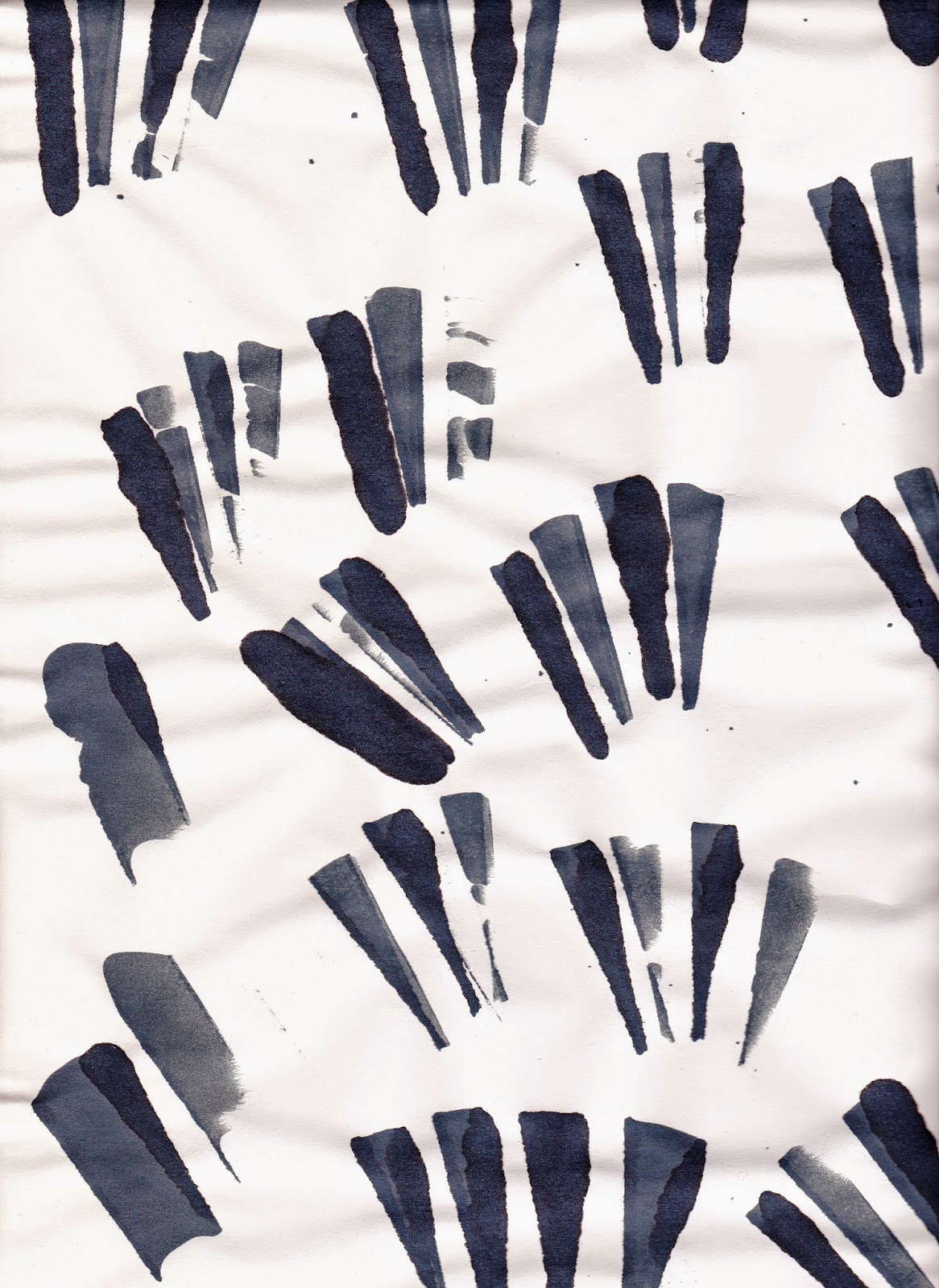
PATTERNED PAPERS - BLEACH MARKS

1
2


3
4


5
6
I tried making marks with bleach on several commercially bought black tissue paper, without success so I painted some white tissue paper with Quink and it worked beautifully.  Again, I like the marks that are closer together or overlapping.  The bleach was a little harder to manipulate with the plastic cards and it was quite blobby.  However, I think it gives a bit more energy with the thick and thin marks.


MODULE 2 - CHAPTER 5

PATTERNED PAPERS


I used Quink ink and black acrylic paint   with a mixture of cardboard strips, hotel key cards and lighter weight plastic cards to make the marks.  I think they are quite interesting, but perhaps there is too much white space in some of them and I should have made the marks closer together or overlapped them to make them more dense.  I will keep that in mind when I make marks on the fabric.

 
1
2

3


4
5
6


7
8


9
10


11
12


13
14


15
16


17
18


19
20

21
22

Friday, May 8, 2015

MODULE 2 CHAPTER 4

DRAWING PATTERNS FROM ANIMAL MARKINGS


Lizard photo taken in Canberra Botanical Gardens, Australia

 Tui photo taken in Wellington Botanical Gardens, New Zealand

Another view of the Tui with photo changed in Photoshop to sketch with graphite pen tool

Picture of shell found on beach in Australia

Photo of snake from the internet

Photo of Loon from internet.  The Loon's haunting cry can be heard on the lake near us all summer

Photo of tortoise from the internet

Picture of dead lobster found on the beach on Roratunga, Cook Islands

Picture of shell found on Australian beach

Picture of Rosella found in my daughter's garden in Canberra, Australia

I used several methods to help me get clearer pictures or closeups of these photos.  I used the cropping tool to isolate some of the pictures, then zoomed in to get a larger view.  I also used Photoshop tools such as Filter,  Sketch, then Graphic Pen or Stamp.  I also used Filter, Artistic then Poster edges, which helped me isolate designs further.   I can see that several of these drawings could be translated into machined strips.  Others could be translated by shibori, or other patterning methods with dyes and paints. I am excited to try them out.


MODULE 2 - CHAPTER 3 (part 2)

MACHINE STRIPS
1a
a few examples of machine stitching


1b
cable stitched examples and a small strip cut from larger piece

I have only done a few examples as I want to do more design work before I do many more strips.

Friday, April 17, 2015

MODULE 2 - CHAPTER 3


TONAL EFFECTS IN MACHINE STITCHERY

1 - zig zag - altered stitch width
2 - zig zag - altered stitch length

a) stitch length to grade from dark to light
b) stitch length and distance between rows to make lighter

c) three step zig zag, using stitch length to grade from light to dark
d) universal stitch, using stitch length, distance and overlapping to create dense area to become light

e) playing with stitch length, width and distance between rows
f) honeycomb stitch (#25)  Playing with width and length

g) Straight Stitch, non parallel rows each row finishing at edge, pivoting, making dark to light area
h) honeycomb stitch (#25) non parallel row finishing at edge, pivoting making dark to light area

ii) Running Stitch (#4) non parallel rows making dark to light areas
iii) Blindstitch (#7) Non parallel rows, making dark to light areas


WHIPSTITCH

j) zig zag whipstitch
k) satin to zig zag whipstitch using white thread in top spool

l) Honecomb whip stitch using white thread then changing to invisible thread on top spool

m) straight whip stitch, white thread in top spool, changing stitch length
m) photocopy of back of sample

n) loose zig zag whip stitch, white thread in top spool, controlling stitch length

CABLE STITCH
o) white perle thread in bobbin, black sewing thread in top - controlling stitch length

p) straight stitch cable, using black perle thread in bobbin and white sewing thread in top, controlling stitch length
q) three step zig zag, working stitch in opposite directions and controlling stitch width